

Sustainability · 2025
In this section51 topics
- Sustainability Policy3 items
- Sustainability Goals & UN SDGs3 items
- Policy Review2 items
- Business Value Chain1 item
- Stakeholder Analysis1 item
- Environmental Sustainability — Overview1 item
- Environmental Policy & Guidelines3 items
- Environmental Policy Review3 items
- Energy — Plan & Guidelines2 items
- Energy — Electricity Consumption1 item
- Energy — Fuel Consumption1 item
- Energy — Targets2 items
- Energy — Performance & Outcomes2 items
- Water — Plan & Guidelines2 items
- Water — Withdrawal, Discharge & Consumption1 item
- Water — Targets2 items
- Water — Performance & Outcomes2 items
- Waste — Plan & Guidelines2 items
- Waste — Generation, Disposal & Recycling1 item
- Waste — Targets2 items
- Waste — Performance & Outcomes2 items
- Greenhouse Gas — Overview1 item
- GHG — Plan & Guidelines3 items
- GHG — Emissions1 item
- GHG — Emissions Verification2 items
- GHG — Principles & Standards1 item
- GHG — Targets1 item
- GHG Targets — Carbon Neutrality1 item
- GHG — Performance & Outcomes2 items
- Environmental Legal Incidents1 item
- Social Policy & Guidelines3 items
- Social Policy Review3 items
- Social — Principles & Standards Practised1 item
- Human Rights Due Diligence2 items
- Employees — Plan & Guidelines3 items
- Employees — Workforce1 item
- Employees — Remuneration & Provident Fund1 item
- Employees — Training & Development1 item
- Employees — Occupational Health & Safety1 item
- Employees — Labour Relations1 item
- Employees — Employee Representation2 items
- Employees — Targets2 items
- Employees — Performance & Outcomes2 items
- Customers — Plan & Guidelines4 items
- Customers — Satisfaction Results1 item
- Customers — Targets2 items
- Customers — Performance & Outcomes2 items
- Community & Social — Plan & Guidelines3 items
- Community & Social — Targets2 items
- Community & Social — Performance & Outcomes2 items
- Law Violation Incidents1 item
Sustainability Policy
Has a Sustainability Policy
Yes
Policy Description
Corporate Commitment to Sustainable Business Practices
The Company recognizes the importance of conducting business responsibly, ensuring accountability to all stakeholders. It integrates a strong commitment to sustainability into its corporate strategy, aiming to create a balanced and long-term impact across economic, social, and environmental dimensions. To uphold this commitment, the Company has established and implemented a Sustainability Management Policy aligned with the United Nations Sustainable Development Goals (SDGs). This policy serves as a framework to enhance operational efficiency across the entire supply chain while actively engaging employees in driving sustainability initiatives through awareness and practices that align with corporate sustainability objectives.
Economic Dimension: The Company promotes good corporate governance, ensuring ethical business practices and accountability to all stakeholders. It is committed to continuously enhancing products and services through innovation that meets evolving customer needs. Additionally, the Company prioritizes efficiency in supply chain management to support sustainable business growth.
Environmental Dimension: The Company emphasizes efficient natural resource management to maintain ecological balance and biodiversity for future generations. It actively promotes environmental awareness among employees, fostering a corporate culture that prioritizes environmental conservation and sustainability in all business operations.
Social Dimension: The Company is dedicated to social responsibility, focusing on creating added value to improve the quality of life for communities and society in a sustainable manner. It also prioritizes the development and well-being of employees, fostering a work environment that encourages growth, job satisfaction, and happiness within the organization.
In addition, the Company shall promote and support stakeholder engagement by prioritizing key stakeholder groups, as well as identifying and assessing material issues relevant to the business (materiality), in order to establish priorities for sustainability management.
All directors, executives, and employees of the PTG Energy Group shall support, drive, and comply with the established sustainability policies and management frameworks.
Page Number in Report
1
Sustainability Goals & UN SDGs
Has Sustainability Goals
Yes
Goals Description
PTG Group conducts its business under the concept of Creating Shared Value, alongside economic growth, the enhancement of social quality of life, and responsible environmental stewardship. The Group remains committed to its vision, “Connecting everyone to opportunities for a better quality of life in all aspects throughout every stage of life,” while upholding the principles of good governance, transparency, and accountability to all stakeholder groups.
Accordingly, the Group has defined its sustainable development direction in alignment with the United Nations Sustainable Development Goals (SDGs) and the evolving environmental, social, and governance (ESG) landscape. Its ultimate objective is to create the highest level of sustainable value for stakeholders under the guiding framework, “Maximize Sustainable Values to PTG’s Stakeholders.”
In addition, the Company has cascaded its Sustainability Management Policy into organization-wide implementation by establishing both short-term and long-term targets, as well as clear strategic directions for corporate sustainability. These efforts are designed to address environmental, social, and governance (ESG) challenges while responding to the expectations of all stakeholder groups, as outlined below.
PTG’s Long-Term Sustainability Goals
The Company aims to drive sustainable growth through three key dimensions: Economic & Governance, Social, and Environmental. The long-term goals are summarized as follows:
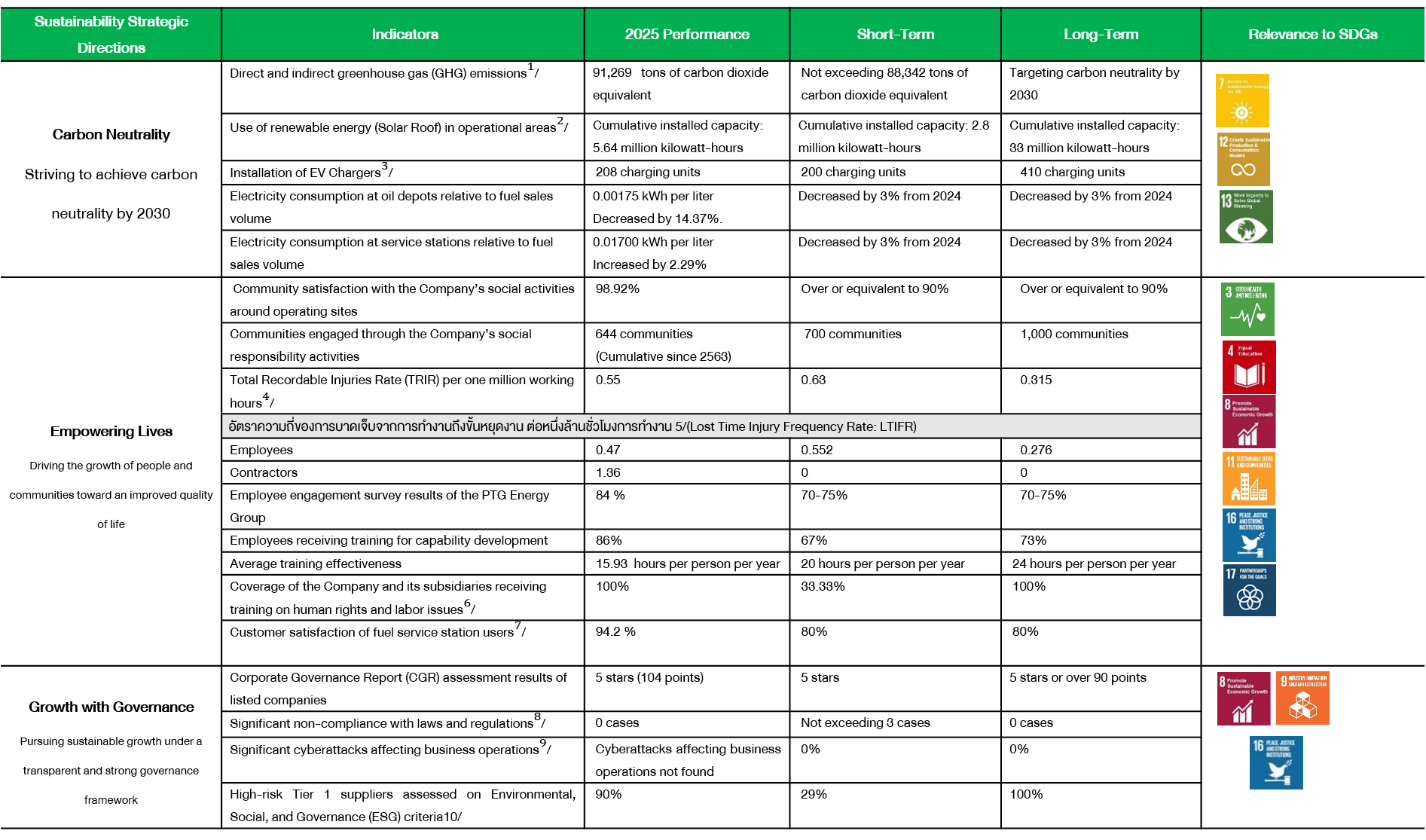
Notes:
1/Direct and indirect greenhouse gas emissions – Scope covers PTG Energy Public Company Limited, PTG Logistics Company Limited, and Petroleum Corporation Company Limited.
2/Use of renewable energy (Solar Roof) at operational sites – Scope covers PTG Energy Public Company Limited, Petroleum Corporation Company Limited, BPTG Company Limited.
3/Number of EV charger installations at service station locations – Scope covers Petroleum Corporation Company Limited, Olympus Oil Company Limited, and BPTG Company Limited.
4/Total Recordable Injury Rate (TRIR) – Scope covers the PTG Energy Group, excluding Atlas Energy Public Company Limited, Clean Community Company Limited, Max Alphabet Company Limited, and Whole Gain Company Limited.
5/Lost Time Injury Frequency Rate (LTIFR) – Scope covers the Company and its subsidiaries, excluding Atlas Energy Public Company Limited.
6/Employees trained on human rights and labor practices – Scope covers the Company and six subsidiaries, namely:
PTG Energy Public Company Limited, Petroleum Corporation Company Limited, Punthai Coffee Company Limited, GFA Corporation (Thailand) Company Limited, and Autobacs Company Limited. In each company and subsidiary, at least 80% of newly hired operational-level employees must receive training.
7/Customer satisfaction among customers purchasing or using products and services under the PT brand.
8/Facts related to cases where the Company receives orders from government authorities or final court judgments imposing fines on the Company or penalties on Company executives for violations of laws related to business operations, with monetary fines of 50,000 baht or more, or involving imprisonment.
9/Percentage of cyberattacks that result in financial impacts and high-level non-financial impacts, and which the Company is unable to prevent.
10/The achievement was below 100% as the supplier was not an active vendor during the annual audit planning period, and was unable to accommodate the audit within the designated timeframe
11/The ratio of electricity consumption per service station to fuel sales volume did not meet the target due to business expansion. The opening of new service stations led to an overall increase in electricity consumption in proportion to the number of stations. In 2025, the Company implemented a Solar Rooftop installation project to reduce reliance on grid electricity. However, during the initial phase, the increase in electricity consumption from newly opened stations and additional facilities exceeded the amount of electricity generated by the Solar Rooftop systems.
UN Sustainable Development Goals
| SDG Goal |
|---|
| Goal 3 Good Health and Well-being |
| Goal 3 Good Health and Well-being |
| Goal 4 Quality Education |
| Goal 4 Quality Education |
| Goal 7 Affordable and Clean Energy |
| Goal 7 Affordable and Clean Energy |
| Goal 8 Decent Work and Economic Growth |
| Goal 8 Decent Work and Economic Growth |
| Goal 9 Industry, Innovation and Infrastructure |
| Goal 9 Industry, Innovation and Infrastructure |
| Goal 11 Sustainable Cities and Communities |
| Goal 11 Sustainable Cities and Communities |
| Goal 12 Responsible Consumption and Production |
| Goal 12 Responsible Consumption and Production |
| Goal 13 Climate Action |
| Goal 13 Climate Action |
| Goal 16 Peace, Justice and Strong Institutions |
| Goal 17 Partnerships for the Goals |
Policy Review
Policy Reviewed This Year
Yes
Policy Changed This Year
No
Business Value Chain
Value Chain Description
The Company recognizes the importance of stakeholder relationship management ( Stakeholder) throughout the supply chain, from upstream to downstream. The Company is committed to creating value through quality products and services to meet expectations and achieve maximum customer satisfaction, through an interconnected business ecosystem encompassing oil business, LPG business, and non-oil business, adhering to the principles of sustainable development to create balance across economic, social, and environmental dimensions, as detailed below:
The Group's key value-creating activities include 5 key activities are as follows:
1.1 Sourcing & Procurement
The Group places importance on selecting and procuring products of high quality and international standards:
Oil and LPG business: As a fuel oil trader under Section 7, the Company procures oil and LPG products directly from leading domestic refineries and gas separation plants that are reliable and meet the standards of the Department of Energy Business. Risk is diversified by not relying on a single producer (Multi-supplier Strategy) to ensure energy security.
Non-Oil business: For the coffee and food businesses, the Company focuses on sourcing agricultural raw materials (e.g., coffee beans) directly from local farmers, supporting sustainable cultivation to obtain high-quality raw materials and generate income for the community.
Cost management: There is a process of negotiation and advance order planning with partners (Demand Planning) for oil, LPG, and gas cylinders, based on global market prices and stock management, to ensure sufficient products for sale and competitive costs.
1.2 Logistics
The Group manages its transportation system through its subsidiary ( PTG Logistics):
Large transport fleet: Possesses a large fleet of its own oil and gas trucks, enabling precise and rapid management of routes and delivery times to oil depots and service stations nationwide (On-time Delivery).
Safety standards: Focuses on operations according to QSSHE standards (Quality, Security, Safety, Health, Environment). All transport vehicles are equipped with GPS Tracking systems, and there is a 24-hour vehicle control center to ensure maximum road safety and prevent impacts on communities during transportation.
1.3. Storage and Inventory
For energy security and comprehensive product distribution:
Oil and gas depots: The Company has oil and gas depots strategically located across all regions of the country (Strategic Locations), supporting transportation and sufficient product reserves to meet consumer demand in each area.
Safety and environment: All warehouses utilize modern technology, with strict fire prevention and leakage control systems. Scheduled maintenance checks are performed, and emergency drills are regularly conducted with local communities to ensure confidence and environmental friendliness.
1.4 Operations
The Company focuses on operational excellence ( Operational Excellence) at service points:
PT Service Stations (COCO Model): The Company's management of most service stations itself (Company Owned Company Operated) allows for strict and consistent control over service standards, cleanliness, and safety nationwide.
Quality inspection: There is a mobile oil quality inspection unit (Mobile Lab) that regularly conducts random checks of oil and gas quality at service stations to ensure customers receive products that are full liter and full quality.
Excellent service: Front-line staff (Service Master/Barista) receive intensive training from the Company's training center (PT Learning Center) to deliver impressive service as if they were family members.
1.5 Marketing & Sales
The Company drives its business with data ( Data-Driven) and service innovation:
Max Card membership system: The Max Card membership database and Max Me Application are used to analyze customer behavior, in order to offer personalized benefits and marketing campaigns (Personalized Marketing).
Diverse distribution channels: Covering fuel stations, LPG stations, household cooking gas retailers, and retail stores (Max Mart, PunThai Coffee) to reach all target customer groups, including transportation, household, and industrial sectors.
Customer Voice: There is a customer service center (Contact Center 1614) and online channels to receive feedback and handle complaints, for continuous service improvement.
Stakeholder Analysis
Stakeholder Analysis
| Stakeholder Type | Stakeholders | Stakeholder Expectations | Response to Expectations | Communication Activities |
|---|---|---|---|---|
| External stakeholders | 2903 · Description: Dealers · 2923 · Description: Customers | Fair pricing, attractive promotions and special privileges, coupled with quality and diverse products and services. Furthermore, there is a demand for transparency in pricing, service terms and conditions, and convenience in accessing service stations. | Oil Business: 1. Expand all PT petrol stations, totaling 2,269 branches. 2. Add 208 EV Charger service points and 124 Max Camp rest stops. 3. Develop new benefits for Max Card Plus. 4. Implement a Local Promotion strategy by creating area-specific promotions tailored to the context of each market. 5. Elevate franchise store standards through digital systems by ensuring all franchise stores install POS and Max Me Shop to ensure accurate sales data, connect to the membership system, and efficiently support promotions. Non-Oil Business: 1. Elevate Barista and service skill standards by reviewing and improving the Be Barista training curriculum, conducting more regional workshops covering employees in various areas, and focusing on work, sales, and customer service skills to ensure consistency across the network. 2. Expand and develop training centers nationwide, with new training centers at CW Tower 3rd floor and Vibhavadi 64 already operational, along with centers in Chonburi, Khon Kaen, and Bangkok. 3. Develop online learning channels to increase accessibility, create monthly online media such as videos and tips for employees, and utilize an E-Learning system to ensure training reaches all areas, with approximately 300 employees completing courses per month. 4. Expand customer base and develop new products to meet the needs of all groups, targeting the New Generation, developing new products from local ingredients, expanding coffee/non-coffee/bakery lines, and developing premium merchandise, while collaborating with partners (Partner / Co-brand) to broaden the customer base. 5. Expand business and increase store formats by opening over 1,900 new branches as planned and piloting new business models, such as Phanthai Boat Noodle restaurants. 6. Build brand awareness and proactive marketing communication by advancing the "Creative Thai Taste" campaign, including "Thon Thai Taste," producing trending content, creating video stories, utilizing Influencers/KOLs, conducting roadshows, and opening flagship stores to enhance brand image, along with preparing presenters to attract the new generation and continuously foster brand growth. | 2941 · Description: Online Communication · 2945 · Description: Complaint Reception · 2947 · Description: Satisfaction Survey · 2948 · Description: Training / Seminar · 2949 · Other name: Social media such as Facebook and Mobile Application PT Max Me · Description: Others |
| Internal stakeholders | 2921 · Description: Employees | Appropriate compensation and benefits, including the use of technology to support efficient work, opportunities for professional training and development, a safe working environment, and equality without discrimination, all within an ethical and transparent organizational culture. | 1. Recruitment and Development of Personnel Access Channels: The organization has continuously expanded its recruitment channels, including dual vocational training programs, collaborations with higher education institutions, and various online platforms, to access qualified candidates in different areas. The company has created its own job search page and participates in social media groups to effectively reach local talent. For new business lines, a specialized recruitment team is in place to acquire personnel with skills aligned with the organization's new ventures. The company collaborates with technology universities, such as Rajamangala University of Technology, by sending teams to support and train students, thereby creating future employment opportunities with the company. 2. Personnel Potential Development and Management: Reviewing internal talent pools to ensure that personnel possess the potential for future growth. Developing Talent Profiles to enhance the potential of personnel for higher positions, primarily focusing on qualifications and performance. Improving the Onboarding process and Development Roadmap to enable new and existing personnel to adapt and grow stably. 3. Employee Experience: The company regularly conducts employee satisfaction surveys to analyze needs and identify areas for improvement in the working environment. The company promotes employee recognition, such as the BEST Awards program and Hall of Fame activities, to boost morale and foster pride in their work. Communication regarding welfare, flexible benefits (Flexi Benefits), and various entitlements is disseminated through online media to ensure employees are fully aware of and understand their due rights. | 2942 · Description: Internal Meeting · 2945 · Description: Complaint Reception · 2946 · Description: Employee Engagement Survey · 2947 · Description: Satisfaction Survey · 2949 · Other name: Income assessment, job valuation, and salary structure review, and Chit Chat activities between supervisors and subordinates. · Description: Others |
| External stakeholders | 2899 · Description: Suppliers | Fair trade conditions, open business opportunities, and adherence to business ethics without corruption, including collaborative development of potential and long-term relationships. | 1. Clearly separate the issuance of purchase orders (PO) by work type to ensure partners understand the scope of work and compensation transparently. 2. Define the payment installment structure based on project value, with 70/30 payment terms, bi-monthly payments, and set a billing timeframe of 60 days and document verification within 14 days. 3. Stipulate in the Terms of Reference (TOR) and contract that contractors must provide a Letter of Guarantee (L/G), clearly define work acceptance criteria, and separate the roles of ordering, inspecting, and approving to control quality and prevent conflicts of interest. 4. Strengthen relationships and capabilities with partners by organizing Kick-Off Meetings to confirm work plans and operational frameworks, and categorize work into product, construction, and licensing groups for easier management, while designing payment installments suitable for small contractors. 5. Conduct partner visits and ESG audits, both onsite and online, for 13 key partners, and follow up on the development of Corrective Action Plans. 6. Organize at least one annual Knowledge Sharing activity on sustainable business practices for partners. 7. Communicate and ensure that key partners are aware of and comply with the Supplier Code of Conduct. | 2938 · Description: Visit · 2941 · Description: Online Communication · 2945 · Description: Complaint Reception · 2948 · Description: Training / Seminar |
| External stakeholders | 2902 · Description: Community | Businesses are expected to help distribute income and support the local economy, operate with fairness, and provide opportunities for community participation in activities and listen to feedback. Most importantly, safety measures, emergency management, and environmental conservation in the area must not be adversely affected. | 1. Organized 4 activities under the company's corporate social responsibility projects, such as the "PT Volunteer Camp: Actively Doing, Never Abandoning" project. 2. Conducted public hearings with nearby communities before commencing construction of service stations. 3. Organized activities in collaboration with the Department of Internal Trade, Ministry of Commerce, by distributing fancy mangoes and boxed milk as a privilege for "PT Max Card and PT Max Plus" members, to assist and generate income for farmers. 4. Provided social contributions to flood victims in various areas. 5. PTG and PT Prachuap FC football club, along with footballers and coaching staff, jointly organized a lunch event and donated 3,000 pairs of shorts, as well as daily necessities, to beneficiaries at the Prachuap Khiri Khan Homeless Protection Center. 6. Awarded 2 scholarships, each worth 147,000 Baht, to students of the Faculty of Commerce and Accountancy, Chulalongkorn University, supporting tuition fees for students for 7 semesters. 7. Local employment, including the employment of persons with disabilities and the elderly. 8. TU Co-Learning Space by PTG, a prototype off-classroom learning space, provides students with opportunities to think and act through various activities from PTG's affiliated businesses. 9. CBS Cafe by PTG provides students with opportunities to experience real business operations in all dimensions, preparing them to become effective entrepreneurs or executives in the future. | 2940 · Description: Social Event · 2945 · Description: Complaint Reception · 2947 · Description: Satisfaction Survey |
| External stakeholders | 2904 · Description: Investors or investment institutions · 2913 · Description: Shareholders | Stable growth in operating results, appropriate dividend payments, and strategies for creating added value for the company, while also emphasizing good governance, transparent information disclosure, risk management (especially in the energy sector), and business operations in accordance with ESG standards. For institutional investors, special emphasis will be placed on reliable environmental data disclosure. | 1. Consistent and systematic communication of operating results: Organize analyst briefings to report quarterly operating results. Organize analyst meetings and participate in investor relations activities of the Stock Exchange of Thailand (SET Opportunity Day and SET Digital Roadshow), along with preparing transcripts and summaries to enhance information accessibility, reduce listening time, and help investors quickly grasp key issues. Organize Investor Visit activities for retail investors to enhance business understanding and provide opportunities for direct communication with management. 2) Full, transparent, and verifiable disclosure of operating results: Prepare Management's Discussion and Analysis (MD&A) every quarter. Prepare Quarterly Earnings Presentations and Key Takeaways to summarize important information for easy understanding. Prepare quarterly and annual Factsheets to provide essential business information to shareholders and investors. 3) Building strategic understanding through investor activities: Organize an annual Business Review event to explain business plans, future outlook, and growth drivers to analysts and securities firms. 4) Fair and transparent engagement with shareholders and investors: Organize physical Annual General Meetings (AGMs) to provide shareholders with opportunities to ask questions and offer direct feedback. Continuously respond to questions and provide information to shareholders as appropriate through IR channels. Organize site visits to the group's facilities to enhance understanding of overall business operations. 6) Responding to investor expectations regarding ESG: Respond to ESG assessments from investors, securities firms, and requesting shareholders. Organize ESG Engagement Sessions with analysts to provide strategic information and exchange views on sustainable business directions. Disclose environmental, social, and governance (ESG) information in accordance with Thai and international standards. | 2938 · Description: Visit · 2939 · Description: Press Release · 2941 · Description: Online Communication · 2943 · Description: External Meeting · 2944 · Description: Annual General Meeting (AGM) · 2947 · Description: Satisfaction Survey · 2949 · Other name: Quarterly Performance Announcement and Domestic and International Roadshows · Description: Others |
| External stakeholders | 2931 · Description: Government agencies and Regulators | 1. Comply with established rules, regulations, laws, and policies. 2. Maintain ethics and transparency in business operations. 3. Cooperate in communication and operations with government agencies. | 1. Comply with all relevant laws, regulations, and rules pertaining to business operations in a correct and transparent manner. 2. Control environmental quality to meet legally mandated standards. 3. Participate in and support various projects and activities in collaboration with government agencies. 4. Consult with relevant government officials to ensure compliance with local laws. 5. Monitor the operations of various departments within the company to ensure correctness and transparency as required by law through a legal compliance audit program. 6. Submit accurate information to government agencies within the specified timeframe. | 2943 · Description: External Meeting · 2949 · Other name: Meeting with government agencies · Description: Others |
| External stakeholders | 2925 · Description: Financial institution | 1. Comply with the terms and conditions as stipulated in the contract, including regulations issued by relevant regulatory bodies. 2. Maintain ethics and transparency in business operations. | 1. Strictly adhere to the regulations of financial institutions issued by government agencies. 2. Accurately and promptly respond to inquiries from credit analysts when questions arise. 3. Strictly comply with the terms and conditions of loan and debenture agreements. | 2949 · Other name: Meeting with representatives from financial institutions and participation in financial institution assessments. · Description: Others |
Environmental Sustainability — Overview
Introduction
The Company prioritizes environmental management as a strategic factor impacting its long-term business continuity. Amidst challenges from climate change, limited resource utilization, and increasing stakeholder expectations, the Company has integrated environmental management into its operational processes and business decision-making. This encompasses efficient energy and resource consumption, water management, waste management in line with the circular economy concept, as well as controlling and mitigating environmental impacts from operations in all areas, adhering to the principle of prevention and impact reduction at the source. Regarding climate change, the Company has systematically elevated its greenhouse gas management. This involves collecting and calculating emissions data from business activities, assessing risks and opportunities according to international guidelines, and setting quantitative targets to achieve long-term carbon neutrality. Concurrently, it implements projects to reduce energy consumption, increase the proportion of renewable energy, restore and expand green spaces, and adjust its business portfolio to align with the energy transition. Furthermore, it promotes the participation of employees and stakeholders in fostering an organizational culture that recognizes environmental responsibility, to support the organization's growth while ensuring balanced and sustainable stewardship of natural resources and society.
Environmental Policy & Guidelines
Has an Environmental Policy
Yes
Policy Description
The Company has revised its environmental management policy to keep pace with the business context and significant changes, by considering both internal and external environmental factors concurrently. The policy covers environmental governance, as well as the management framework for Quality, Security, Safety, Occupational Health, and Environment (QSSHE), to ensure that the Group's operations proceed systematically and in a unified direction. The policy review takes into account the Company's sustainability strategy, relevant government policies concerning climate change, as well as environmental, safety, and occupational health risks that may impact business operations. The Company adheres to international management system standards, namely ISO 9001:2015, ISO 14001:2015, and ISO 45001:2018, as a framework for enhancing operational efficiency and risk control. The revised environmental policy reflects the Company's commitment to comprehensively manage the impacts of its business operations, including pollution prevention, climate change adaptation and mitigation, greenhouse gas emission reduction, and biodiversity conservation, to support the creation of business value alongside long-term environmental responsibility. The Company has mandated that PTG Energy Group implement the environmental policy uniformly by integrating the environmental management system with the quality management system and the safety and occupational health management system, to promote efficient resource and energy utilization, reduce environmental impacts from operations, and enhance management continuity at all organizational levels. Beyond system and standard implementation, the Company emphasizes communication and fostering environmental awareness among both internal and external stakeholders through personnel capability development and instilling a culture of Quality, Security, Safety, Occupational Health, and Environment (QSSHE) to support socially and environmentally responsible business operations.
Environmental Guidelines
| Guideline |
|---|
| Electricity Management |
| Fuel Management |
| Renewable/Clean Energy Management |
| Water Management |
| Waste Management |
| Biodiversity Management |
| Greenhouse Gas and Climate Change Management |
Environmental Policy Review
Policy Reviewed This Year
Yes
Review Details
In 2025, PTG Energy Public Company Limited undertook a major review and enhancement of its "Internal Environmental Management Policy." This involved a comprehensive revision of the entire document (4th amendment) to align with international standards and the United Nations Sustainable Development Goals. The key substance focuses on balancing business growth with natural resource conservation, as follows: 1. Elevating climate commitment to international goals through the establishment of clear strategic targets to achieve Carbon Neutrality by 2030. The Company has adopted an Internal Carbon Pricing (ICP) mechanism as a tool to assess risks and support investments in clean energy, while also expanding the scope of greenhouse gas emissions data collection and reporting to cover Scopes 1, 2, and 3. 2. Integration of circular economy concepts and resource efficiency, emphasizing optimal resource management. This focuses on reducing waste at the source, minimizing plastic use, and recycling materials in accordance with circular economy principles, such as Waste-to-Energy business projects, as well as expanding the installation of rooftop solar power generation systems (Solar Roof) at operational sites to promote renewable energy use. 3. Environmentally friendly supply chain management. The Company has extended the scope of enforcement from within the organization to business partners throughout the supply chain. This requires partners, contractors, and service providers to strictly comply with environmental laws and standards, while also promoting green transportation and logistics through intelligent vehicle management systems (Green Fleet / GPS) and energy-saving driving behaviors (Eco-Driving) to reduce air pollution. 4. Comprehensive governance and impact assessment. To ensure transparency, the Company mandates Environmental Impact Assessments (EIA) and community consultations before undertaking any new projects. Furthermore, environmental factors are considered crucial criteria in evaluating mergers and acquisitions (M&A), all under the direct supervision of the Board of Directors, senior management, and the Environmental Committee, to achieve tangible and truly sustainable outcomes.
Policies & Guidelines Changed
| Change | Other — Please Specify |
|---|---|
| Other | Internal Environmental Management Policy |
Energy — Plan & Guidelines
Has an Energy Management Plan
Yes
Plan Description
The Company designates energy management as one of the key issues in its business operations, as the organization's core activities involve energy consumption in both fuel and electricity forms. To enhance efficiency and control potential impacts, the Company has developed a system for monitoring and collecting energy consumption data across all relevant activities, including electricity consumption within offices, fuel consumption by corporate vehicles, and logistics operations. This data is utilized for trend analysis and continuous improvement measure formulation. Based on the collected energy data, the Company has set medium-term energy consumption targets (3–5 years), using 2024 as the baseline year. These targets aim to reduce energy intensity in key areas, specifically: a 3% reduction in electricity consumption per oil sales volume through oil depots and service stations, a 3% reduction in electricity consumption per employee at the head office, and a 3% reduction in the average fuel consumption of corporate vehicles. To drive the achievement of these targets, the Company implements energy management measures concurrently, encompassing both systemic and behavioral approaches. Regular internal campaigns and communications are conducted to promote appropriate energy use and foster employee participation in energy reduction activities within the head office.
Energy — Electricity Consumption
Electricity Consumption
| Metric | Current Year | Previous Year | Two Years Ago |
|---|---|---|---|
| Total electricity consumption within the organization (Kilowatt-Hours) | 76,666,607.9 | 91,310,854.84 | 73,099,821.01 |
| Electricity purchased for consumption from non-renewable energy sources (Kilowatt-Hours) | 71,024,404.49 | 87,602,265.84 | 71,781,814.01 |
| Electricity purchased or generated for consumption from renewable energy sources (Kilowatt-Hours) | 5,642,203.41 | 3,708,589 | 1,318,007 |
Energy — Fuel Consumption
Fuel Consumption
| Metric | Current Year | Previous Year | Two Years Ago |
|---|---|---|---|
| Crude oil (Barrels) | |||
| Coal (Metric tonnes) | |||
| Jet fuel (Litres) | |||
| Diesel (Litres) | 20,885,347.55 | 19,894,499.35 | 18,928,131.64 |
| Gasoline (Litres) | 776,807.28 | 918,212.98 | 284,126.41 |
| Fuel oil (Litres) | |||
| Natural gas (Standard cubic feet) | |||
| LPG (Kilograms) | 1,674 | 828.63 | |
| Steam (Metric tonnes) |
Energy — Targets
Has Set Targets
Yes
Targets
| Target | Base Year | Base Year Value | Target Year | Target Change (%) | Unit | Per Unit (Intensity) | Per Unit — Please Specify |
|---|---|---|---|---|---|---|---|
| Reduction of electricity purchased for consumption | 2,024 | 0 | 2,025 | 3 | Kilowatt-hour | Litre of product | Litre of product |
| Reduction of fuel consumption | 2,024 | 0.01 | 2,025 | 3 | Kilowatt-hour | Litre of product | Litre of product |
Energy — Performance & Outcomes
Has Performance Results
Yes
Performance Description
The Company focuses on enhancing energy efficiency throughout its business value chain by continuously reducing electricity consumption at its headquarters and oil depots. This is achieved through communication to raise awareness and promote employee participation in appropriate energy usage, alongside organizing environmentally friendly meetings (Green Meetings). Furthermore, the Company has upgraded its fuel management with a digital tracking and data recording system to meticulously monitor consumption and analyze excesses, which are reported to the management committee monthly. This aims to efficiently control energy costs and reduce operational pollution. In addition, the Company has actively pursued renewable energy by installing rooftop solar power generation systems (Solar Roof) at three oil depots: Maeklong Oil Depot, Khon Kaen Oil Depot, and Surin Oil Depot. This is to replace grid electricity usage and reduce greenhouse gas emissions. In 2025, the Company also successfully implemented the Inno-green Station prototype project at Khlong Luang 10 branch. This project integrates Eco-Design with smart technologies, such as the full installation of LED lighting systems and the use of energy-saving air conditioners (Energy Label No. 5) combined with an automatic control system (MARUTTO), which can reduce electricity consumption by up to 20.30%. It also includes the installation of thermal insulation and translucent roofing panels to maximize the utilization of natural light. As a result, the prototype station has received standard certification from the Thailand Environment Institute (TEI). This underscores the Company's commitment to driving the organization towards sustainability and truly maximizing resource utilization throughout its business value chain.
Water — Plan & Guidelines
Has a Water Management Plan
Yes
Plan Description
Amidst Thailand's challenging water resource situation, encompassing issues of scarcity and deteriorating water quality, efficient water management is a crucial factor for business continuity and sustainable resource utilization. The Company recognizes that water usage in business activities, if not properly managed, could lead to adverse impacts on the environment, communities, and the organization's long-term operations. For this reason, the Company prioritizes the valuable and responsible use of water resources throughout its operational processes, from drawing water from sources for various activities to wastewater management. This includes systematic assessment and control of related risks, as well as water quality analysis before discharge back into the environment, to ensure compliance with regulations and prevent adverse effects on surrounding communities. In conjunction with proactive management, the Company has set water usage targets for the next 3–5 years, with 2024 as the baseline year, to enhance water efficiency in its core activities. These include reducing the proportion of tap water consumption per oil sales through oil depots and service stations by 2%, and decreasing the water consumption rate per employee from activities within the head office premises by 3%. These approaches reflect the Company's commitment to prudent water resource management, aiming for efficient water use, reducing environmental and social impacts, and supporting long-term sustainable business operations.
Water — Withdrawal, Discharge & Consumption
Water Withdrawal, Discharge & Consumption
| Metric | Current Year | Previous Year | Two Years Ago | Remark |
|---|---|---|---|---|
| Total water withdrawal (Cubic meters) | 2,706,095.18 | 3,545,227.1 | 2,331,977.57 | Water consumption data from 2018-2021 covered PTG's operational sites, namely the Head Office and oil depots. In 2022, the scope was expanded to include PTG Logistics Company Limited and gas stations under the management of Petroleum Thai Corporation Company Limited. However, from 2023 onwards, the scope has been extended to cover distribution centers. |
| Total water withdrawal by third-party water (Cubic meters) | 2,411,905.92 | 2,822,702.36 | 1,655,527.43 | |
| Total water withdrawal by surface water (Cubic meters) | ||||
| Total water withdrawal by groundwater (Cubic meters) | 294,189.26 | 722,524.74 | 676,450.14 | |
| Total water withdrawal by seawater (Cubic meters) | ||||
| Total water withdrawal by produced water (Cubic meters) | ||||
| Percentage of wastewater treated before discharge (%) | 100 | 100 | 100 | |
| Total water discharge (Cubic meters) | 2,164,876.15 | 39,981.99 | 32,930 | |
| Total water discharge to third-party water (Cubic meters) | ||||
| Total water discharge to surface water (Cubic meters) | 2,164,876.15 | 39,981.99 | 32,930 | The wastewater volume reported for 2024 is data collected exclusively from oil depot areas. However, starting from 2025, the Company will revise its criteria for measuring and calculating wastewater volume, referencing the "Wastewater Volume Calculation Manual of the Pollution Control Department" to ensure comprehensive coverage and adherence to international standards. This may lead to a significant change in wastewater volume figures compared to the previous baseline year. |
| Total water discharge to groundwater (Cubic meters) | ||||
| Total water discharge to seawater (Cubic meters) | 0 | 0 | 0 | |
| Total water consumption (Cubic meters) | 541,219.03 | 3,505,245.11 | 2,299,047.57 | |
| Recycled water (Cubic meters) |
Water — Targets
Has Set Targets
Yes
Targets
| Target | Base Year | Base Year Value | Target Year | Target Change (%) | Unit | Per Unit (Intensity) | Per Unit — Please Specify |
|---|---|---|---|---|---|---|---|
| Reduction of water consumption | 2,024 | 0 | 2,024 | 3 | Cubic meters | Litre of product | Litre of product |
| Reduction of water withdrawal | 2,024 | 0 | 2,025 | 3 | Cubic meters | Litre of product | Litre of product |
Water — Performance & Outcomes
Has Performance Results
Yes
Performance Description
The Company has developed a systematic water management framework covering all operational areas of the group, from the head office and oil depots to service stations. This framework focuses on raising awareness and promoting efficient water usage, coupled with sustainable environmental care. At the service station level, the Company prioritizes close control and monitoring of water usage. This is achieved through regular recording of water meter data to detect anomalies, analyze water consumption trends, and identify potential water loss points due to equipment leaks. Should any anomalies be detected, branch managers or district managers will immediately coordinate corrective actions and repairs to enhance water efficiency in each area. Furthermore, the Company has established appropriate water usage guidelines for cleaning tasks, such as using equipment with controllable on-off valves at the end of hoses and adjusting water pressure to an appropriate level for use, thereby avoiding unnecessary water loss while maintaining quality service standards. Regarding wastewater management from service stations, the Company mandates that all branches regularly maintain and clean grease traps at least once a week to prevent wastewater issues and unpleasant odors. Concurrently, the Company promotes source-based wastewater management by requiring tenants within the premises to install appropriate wastewater treatment systems or grease traps, and by communicating to employees and tenants to avoid disposing of waste, food scraps, or chemicals directly into the drainage system. These measures reflect the Company's concrete commitment to reducing water consumption and controlling wastewater impacts, alongside conducting business with consideration for the environment and long-term sustainability. Additionally, at the Nong Khae oil depot, the "Every Drop Counts" project has been implemented, focusing on addressing wasteful water usage in corporate car washing activities. This involves a phased system improvement plan, starting with the installation of a water filtration system to enable sustainable water recycling, coupled with the development of safety standard manuals and regular equipment maintenance. Furthermore, emphasis is placed on fostering employee awareness through 5S activities to promote a culture of valuing resources and demonstrating concrete environmental responsibility.
Waste — Plan & Guidelines
Has a Waste Management Plan
Yes
Plan Description
The Company has established a systematic framework for waste and refuse management, based on defined waste and refuse management operating procedures, to control the management of waste generated from various work processes and activities within operational areas. This covers sorting, collection, storage, and disposal appropriate to the type of waste. Furthermore, the Company has adopted the circular economy concept ( Circular Economy) and applied it, focusing on reducing waste generation at the source, utilizing resources efficiently, and promoting the reuse of resources to minimize the amount of waste requiring disposal and reduce impacts on the environment and surrounding communities.
The Company has set long-term goals for waste and refuse management, aiming for 100% of all hazardous waste and refuse generated to be managed and disposed of correctly in accordance with relevant laws and regulations, with an emphasis on management according to the waste management hierarchy ( Waste Management Hierarchy) from waste reduction, reuse, and recycling to appropriate disposal. To support the achievement of this goal, the Company has set quantitative indicators for reducing waste generation from office activities, with 2023 as the base year. These include a 3% reduction in the average monthly paper consumption at the head office and a 3% reduction in the average amount of general waste per employee from activities within the head office, which is part of driving efficient resource utilization in line with the circular economy concept.
Such operational guidelines reflect the Company's commitment to responsible waste and refuse management, coupled with enhancing resource efficiency, reducing reliance on new resources, and creating added value from existing resources, thereby supporting long-term sustainable business operations in accordance with circular economy principles.
Waste — Generation, Disposal & Recycling
Waste Generation, Disposal & Recycling
| Metric | Current Year | Previous Year | Two Years Ago | Remark |
|---|---|---|---|---|
| Total waste generated (Kilograms) | 295,147.03 | 265,300 | 115,214.4 | Waste management data from 2018-2021 covered PTG's operational sites, namely the Head Office and oil depots. In 2022, the scope was expanded to include PTG Logistics Company Limited. However, from 2023 onwards, the scope has been extended to cover distribution centers. |
| Non-hazardous waste (Kilograms) | 221,670.23 | 133,330 | 86,053.6 | Waste management data for the years 2018-2021 covered PTG's operational sites, namely the Head Office and oil depots. In 2022, the scope was expanded to include PTG Logistics Company Limited. However, from 2023 onwards, the scope has been expanded to cover distribution centers. This data includes the volume of hazardous and non-hazardous waste that is still stored on-site, awaiting subsequent disposal rounds. |
| Non-hazardous waste - Landfilling (Kilograms) | 221,670.23 | 2,380 | 1,228.2 | |
| Non-hazardous waste - Incineration (with energy recovery) (Kilograms) | 0 | 3,500 | 0 | |
| Non-hazardous waste - Incineration (without energy recovery) (Kilograms) | 0 | 3,500 | 7,800 | |
| Non-hazardous waste - Other disposal operations (Kilograms) | 0 | 123,950 | 77,025.4 | |
| Hazardous waste (Kilograms) | 73,476.8 | 131,970 | 29,160.8 | |
| Hazardous waste - Landfilling (Kilograms) | 0 | 0 | 0 | |
| Hazardous waste - Incineration (with energy recovery) (Kilograms) | 73,030 | 0 | 31.4 | |
| Hazardous waste - Incineration (without energy recovery) (Kilograms) | 446.8 | 8,020 | 5,588 | |
| Hazardous waste - Other disposal operations (Kilograms) | 0 | 123,950 | 23,541.4 | |
| Total reused/recycled waste (Kilograms) | 703,645.85 | 105,993 | 20,430 | |
| Reused/Recycled non-hazardous waste (Kilograms) | 247,359.55 | 104,503 | 14,650 | |
| Reused non-hazardous waste (Kilograms) | ||||
| Recycled non-hazardous waste (Kilograms) | 247,359.55 | 104,503 | 14,650 | |
| Reused/Recycled hazardous waste (Kilograms) | 456,286.3 | 1,490 | 5,780 | |
| Reused hazardous waste (Kilograms) | ||||
| Recycled hazardous waste (Kilograms) | 1,490 | 5,780 |
Waste — Targets
Has Set Targets
Yes
Targets
| Waste Type | Disposal Approach | Target | Target Year | Target Change (%) | Unit |
|---|---|---|---|---|---|
| Non-hazardous waste | 2758 · Description: Reuse · 2759 · Description: Recycle · 2763 · Other name: Outsourcing waste disposal · Description: Other | Reduce waste volume | 2,024 | 3 | Kilograms |
| Hazardous waste | 2763 · Other name: Outsourcing waste disposal · Description: Other | Reduce waste volume | 2,025 | 100 | Kilograms |
Waste — Performance & Outcomes
Has Performance Results
Yes
Performance Description
The Company focuses on conducting business based on environmental responsibility, adhering to the concept of a Circular Economy and the 3Rs principles (Reduce, Reuse, Recycle) as key mechanisms for maximizing resource management efficiency. To achieve the goal of reducing waste generated from business activities, the Company has established a concrete waste data collection system, covering processes from source separation, weighing, and detailed statistical recording by waste type. Data accuracy is jointly verified between internal departments and authorized waste disposal contractors to ensure transparency and enable precise application of data in environmental strategic planning. Over the past year, the Company has expanded its operations to specifically manage hazardous waste by installing electronic waste (E-Waste) collection points within office premises to promote proper product disposal in accordance with international standards. This is coupled with significant operational impact prevention measures, such as preventing oil spills into water sources through the installation of boom systems and regularly testing the integrity of oil transfer equipment according to specified cycles. Furthermore, emergency response drills are conducted at least twice a year to build readiness for incidents and mitigate ecological impacts in unforeseen circumstances. Moreover, the Company encourages employees at all levels to participate in driving a green organization through the presentation of innovative ideas and Kaizen (continuous improvement) processes to further enhance waste management efficiency. This culture of learning not only instills an awareness of valuable resource utilization but also fosters a network of collaboration with business partners to initiate concrete environmental projects, thereby demonstrating the Company's commitment to conducting business while creating shared value for society and the environment sustainably.
Greenhouse Gas — Overview
Introduction
Climate change is not merely an environmental risk, but a structural factor that is shaping competitive landscapes, business models, and the ability to create long-term value. Amidst the transition to a low-carbon economy and increasingly stringent environmental regulations at both national and global levels, the Company has elevated climate change management to a key mechanism within its corporate strategy to enhance the resilience and adaptability of its business across all dimensions. The Company systematically collects, analyzes, and monitors greenhouse gas emissions data from its business activities, and assesses climate change-related risks and opportunities, referencing the framework of the Task Force on Climate-related Financial Disclosures (TCFD) to understand potential impacts on operations, value chains, and future strategic decisions. This data serves as a basis for defining mitigation, adaptation, and investment measures aligned with the evolving global context. In practice, the Company adjusts its business operations to support both direct and indirect greenhouse gas emission reductions, such as improving energy and fuel efficiency, expanding the use of renewable energy, and designing resource-efficient work processes. This is coupled with implementing environmental projects that help reduce or enhance greenhouse gas sinks, such as reforestation and the restoration of green spaces in communities. These initiatives not only mitigate climate impacts but also create shared value for society and stakeholders in the long term.
GHG — Plan & Guidelines
Has a GHG Management Plan
Yes
Plan Description
Within the context of the energy transition, the Company has set a target to achieve Carbon Neutrality by 2030 for Scope 1 and Scope 2 greenhouse gas emissions. This target is viewed not merely as reducing environmental impact, but as an opportunity to enhance operational efficiency, build stakeholder confidence, and lay the foundation for long-term sustainable growth. To achieve this goal, the Company has established a climate strategy under three main approaches, namely:
Reduce Reduce greenhouse gas emissions from the source through enhancing operational efficiency, systematic energy and resource management, and promoting the use of renewable energy, coupled with fostering an organizational culture that supports responsible resource utilization and employee engagement at all levels.
Reforest Support the increase of greenhouse gas sinks through afforestation and ecosystem restoration, relying on collaboration with various sectors to create sustainable environmental and social outcomes, while also promoting long-term natural resource conservation.
Re-adjust Portfolio Adjust the business portfolio to align with the energy transition and the low-carbon economy direction, focusing on developing and investing in businesses that create new opportunities for reducing greenhouse gas emissions. Renewable Energy business has been designated as one of the core businesses to support sustainable growth and value creation in the future.
Plan Document Link
https://investor.ptgenergy.co.th/storage/content/corporate-governance/downloads/corporate-governance-policy/2025/20250318-ptg-climate-change-management-strategy-en.pdf
GHG — Emissions
GHG Emissions
| Metric | Current Year | Previous Year | Two Years Ago | Remark |
|---|---|---|---|---|
| Total GHG emissions (Metric tonnes of carbon dioxide equivalent) | 14,971,801.47 | 15,524,991 | 15,376,312 | Greenhouse gas emissions data was collected using the Operational Control method, in accordance with the GHG Protocol guidelines. The scope of data collection in 2022 included the Head Office, oil depots, PTG Logistics Company Limited, and service stations under the management of Petroleum Thai Corporation Company Limited. The scope of data collection for 2023 - 2024 included the Head Office, oil depots, distribution centers, PTG Logistics Company Limited, and service stations under the management of Petroleum Thai Corporation Company Limited. |
| Total greenhouse gas emissions 1 (Metric tonnes of carbon dioxide equivalent) | 57,532 | 55,159 | 50,717 | |
| Total greenhouse gas emissions 2 (Metric tonnes of carbon dioxide equivalent) | 33,736.59 | 37,834 | 38,307 | |
| Total greenhouse gas emissions 3 (Metric tonnes of carbon dioxide equivalent) | 14,880,532.88 | 15,431,998 | 15,287,288 | From 2021 to 2023, the Company reported Scope 3 greenhouse gas emissions data using full reporting methodology. However, starting from 2024 onwards, the Company has adjusted its calculation methodology by selecting only significant categories to ensure that reporting accurately and appropriately reflects environmental impacts. This approach aligns with the GHG Protocol framework to enhance the efficiency and accuracy of the organization's greenhouse gas emissions management. |
GHG — Emissions Verification
Emissions Verified by a Third Party
Yes
Verifying Body
2649
GHG — Principles & Standards
Principles & Standards Applied
| Standard |
|---|
| 2671 |
| 2672 |
| 2676 |
| 2677 |
GHG — Targets
Has Set GHG Targets
Yes
GHG Targets — Carbon Neutrality
Carbon Neutrality Targets
| Emission Scope | Carbon Neutrality Certified | Base Year | Base Year Emissions | Target Year | Unit |
|---|---|---|---|---|---|
| 2715 | N | 2,024 | 92,992 | 2,030 | Metric tonnes of carbon dioxide equivalent |
GHG — Performance & Outcomes
Has Performance Results
Yes
Performance Description
To support concrete and verifiable greenhouse gas emission reduction targets, the Company has initiated environmental projects that yield quantifiable results and registered them under the Thailand Voluntary Emission Reduction Program (T-VER). Currently, the Company has successfully registered a total of 4 T-VER projects, namely: the Sustainable Rice Project to reduce methane emissions through alternate wetting and drying (AWD) in Suphanburi Province, the Mangrove Reforestation Project for carbon credit benefits in Krabi Province, the Solar Power Generation Project, and the Solar Rooftop Project at PT gas and service stations. These projects reflect a comprehensive approach to greenhouse gas emission reduction, covering both direct and indirect activities, as well as creating carbon sinks alongside the use of clean energy. Furthermore, the Company continuously implements energy transition and greenhouse gas emission reduction projects to enhance its potential in achieving long-term carbon neutrality goals. Examples include the pilot project for using 3 electric trucks (EV Trucks) to upgrade the transportation system to be efficient and environmentally friendly, which has reduced fuel consumption by approximately 451 liters and greenhouse gas emissions by 1.235 tons of carbon dioxide equivalent. Concurrently, the Company has continuously expanded the installation of Solar Rooftop power generation systems since 2020 to support the use of clean energy and reduce electricity consumption from the grid. Currently, installations cover a total of 216 locations, with a combined production capacity of 6.63 million kilowatt-hours per year. This also includes expanding infrastructure to support electric vehicles through collaboration with the Electricity Generating Authority of Thailand (EGAT) for the installation of EV Charging Stations within service stations. By 2025, the Company has installed 208 charging points to accommodate the growth of electric vehicles and meet the demand for comprehensive energy services in the future.
Environmental Legal Incidents
Legal Violation Incidents
| Metric | Current Year | Previous Year | Two Years Ago |
|---|---|---|---|
| Number of cases or incidents of legal violations or negative environmental impact (cases) | 0 | 0 | 0 |
Employees — Plan & Guidelines
Has an Employee Management Plan
Yes
Plan Description
Employee Human Rights
The Company emphasizes respect for human rights and fair labor practices, covering all levels of operations, to ensure that all employees and stakeholders are treated equally and fairly. The organization is committed to not using forced labor, trafficked labor, or illegal child labor, and does not support punishment or practices that constitute physical and psychological abuse, whether through intimidation, detention, restraint, harassment, or any form of violence. Furthermore, the Company implements fair labor policies from recruitment, compensation, potential development, performance evaluation, to career advancement planning, without discrimination. It also prioritizes creating a safe working environment conducive to employees' good quality of life through health, hygiene, and safety measures, as well as providing opportunities for employees to participate in expressing opinions and managing welfare through the Welfare Committee in the establishment, to ensure that all employees receive appropriate care under transparent and fair policies.
Employee Compensation and Benefits
The Company sets employee salaries in line with job value by position, cost of living, legal minimum wage, and considers them comparable to leading businesses of the same type in Thailand, as well as the current and future competitive business environment. Additionally, there is a special area allowance program in areas with high labor market competition, along with a policy to pay employees appropriate compensation that aligns with the Company's short-term and long-term performance. Short-term incentives include annual bonuses (Annual Bonus), sales incentives (Incentive) or new branch expansion (Commission plan), oil loss control incentives (Oil Loss Control Incentive), service standard control incentives (Service Standard Incentive). Long-term incentives involve the Company's policy to incentivize and retain employees to generate long-term results for the organization by granting the right to purchase company shares at a specified price (Stock Option). Employees benefit as the Company's profits increase, leading to a greater value of their shares, increased earnings per share, and higher annual dividends, in line with the Company's continuously improving performance.
Employee Training and Development
The Company is committed to enhancing the potential of employees at both staff and management levels. The human resource development approach follows the framework of Role - Based Competency by focusing on strengthening Skill Growth that align with core competency requirements ( Core Competency ) for each job position and appropriate courses to enhance capabilities and strengthen potential for further organizational development, ensuring that personnel are ready to compete in the business landscape. Furthermore, the Company is committed to employee development, with its primary goal being to cultivate employee capabilities through learning using both online and offline methods and platforms, offering diverse learning formats such as classroom learning ( Classroom ) , practical workshops ( Workshop ) , online courses ( Virtual Training ) , e-learning through multimedia platforms ( e - Learning ) , practical training ( On the Job Training : OJT ) where employees learn while performing their duties , cross-functional learning ( Cross Functional ) in the form of project-based assignments ( Project Based ) and interactive learning ( Action Learning ) etc.
The Company is committed to ensuring that all employees have the opportunity to develop essential skills and unlock their full potential, in alignment with the specific competencies required in their respective professions and various fields.
Employee Retention
The Company emphasizes systematic monitoring and development of employee performance by conducting annual performance evaluations to reflect concrete operational results. This evaluation process includes providing feedback ( Feedback ) providing guidance, assistance, and problem-solving, as well as continuous improvement and development ( Coaching and Continuous Improvement ) to enhance employees' potential to perform effectively and align with organizational goals.
The Company has established comprehensive performance evaluation criteria linked to both short-term and long-term business strategies and directions. These criteria include financial performance indicators ( Financial ) Non-financial indicators ( Non - Financial ) and sustainability development indicators ( Sustainability Development ) which involves cascading indicators from the corporate level ( Corporate Level ) to division or department level ( Division Level ) and individual level ( Individual Level ) according to the suitability of roles and responsibilities in each position. Furthermore, the Company also evaluates behavior based on corporate values “ Do Your BEST ” to strengthen corporate culture and align with sustainable business practices. For management level 9 – 14 The Company has implemented a 360 degrees, is used as a tool for assessing behavior and potential. The assessed individuals conduct self-assessments alongside evaluations from supervisors, colleagues, and subordinates to reflect diverse and comprehensive perspectives. This process helps executives clearly and accurately identify strengths and areas for development, leading to efficient and continuous development of managerial personnel's potential.
Furthermore, the Company emphasizes fostering employee engagement with the organization to understand employees' needs and continuously develop projects and activities to enhance employee engagement. The Company mandates an annual assessment of employee engagement, with assessment topics divided into 4 The main topics are:
Employee Engagement Survey The Company focuses on assessing employee job satisfaction, which involves behavioral questions, evaluating employees' experiences across various categories such as organizational values, corporate reputation, opportunities for potential development, infrastructure, and resources, among others. This aims to ensure employees feel satisfied and can work efficiently, leading to a positive relationship with business outcomes in terms of retaining talented individuals, organizational efficiency, customer satisfaction, and corporate revenue.
Employee Job Satisfaction Assessment regarding clarity of goals and the meaning of the work performed. Employees who feel their work is important and connected to organizational goals tend to have higher engagement and motivation, leading to increased efficiency in work processes.
Employee Happiness Level Survey through Experienced Encounters such as good relationships with supervisors and colleagues, workplace safety, and appropriate infrastructure and welfare, to ensure employees continuously feel happy at work.
The Company prioritizes reducing factors that create stress or pressure at work. by assessing employees' stress levels through questions about workload, work-life balance, and access to resources or support when facing challenges, to help improve the working environment.
Occupational Safety and Health
The Company has established a Quality, Security, Safety, Occupational Health, and Environment Policy to serve as a framework for managing security, safety, occupational health, and environment ( SSHE ) within the Group. This policy is regularly reviewed for suitability and currency by the Safety, Occupational Health, and Environment Policy Oversight Committee to continuously control operations, services, and improve efficiency. The Company has adopted this policy as a guideline for developing the management system for SSHE of the Group, under the name “ PTG SSHE Management System ( PTG SSHEMS )” The goal of the is to achieve the following results:
Zero Accident
Zero Environmental Claim
Zero Security Incident
Zero Process Safety Event
Furthermore, the Company also conducts audits of the management system for SSHE at least once a year, alongside audits according to relevant international standards, including quality management system standards ISO 9001 , environmental management systems ISO 14001 , ISO 45001 to ensure that the management system is effective, compliant with requirements, and continuously developed.
Plan Areas
| Plan Area |
|---|
| Fair employee compensation |
| Employee training and development |
| Promoting employee relations and participation |
| Migrant/foreign labor |
| Child labor |
| Occupational health and safety in workplace |
Employees — Workforce
Workforce Data
| Metric | Current Year | Previous Year | Two Years Ago |
|---|---|---|---|
| Total number of employees (Persons) | 34,053 | 25,755 | 21,432 |
| Number of male employees (Persons) | |||
| Number of female employees (Persons) | |||
| Total employment of disabled persons (people) | 226 | 195 | 194 |
| Total disabled employees (people) | 23 | 31 | 23 |
| Total male disabled employees (people) | 11 | 16 | 14 |
| Total female disabled employees (people) | 12 | 15 | 9 |
| Total disabled workers who are non-employee (people) | 203 | 164 | 171 |
| Contributions to the fund for promoting and improving the quality of life for disabled persons | 1 | 1 | 1 |
| Total number of male employees in operational level (Persons) | |||
| Total number of male employees in management level (Persons) | |||
| Total number of male employees in executive level (Persons) | |||
| Total number of female employees in operational level (Persons) | |||
| Total number of female employees in management level (Persons) | |||
| Total number of female employees in executive level (Persons) |
Employees — Remuneration & Provident Fund
Remuneration & Provident Fund
| Metric | Current Year | Previous Year | Two Years Ago | Remark |
|---|---|---|---|---|
| Total disabled employees (people) | 6,015,745,224.49 | 4,613,824,621.56 | 3,849,520,100.05 | This information presents the total employee compensation, which is calculated from the compensation paid to employees at the end of each month. |
| Total male employee remuneration (Baht) | ||||
| Total female employee remuneration (Baht) | ||||
| Number of employees eligible to participate in PVD (persons) | 20,641 | 13,686 | 11,289 | |
| Total number of employees joining employee provident fund (Persons) | 3,935 | 2,740 | 2,191 | |
| Percentage of total number of employees joining employee provident fund to total number of employees (%) | 11.56 | 10.64 | 10.22 | |
| Number of PVD members / Total eligible employees (%) | 19.06 | 20.02 | 19.41 | |
| Total amount of provident fund contributed by the Company (Baht) | 43,926,273.07 | 35,305,156.71 | 27,726,892.62 | |
| Total amount of provident fund contributed by employee (baht) | 85,385,405.29 | 66,676,358.58 | 54,917,598.96 |
Employees — Training & Development
Training Data
| Metric | Current Year | Previous Year | Two Years Ago |
|---|---|---|---|
| Average employee training hours (Hours / Person / Year) | 15.93 | 20.94 | 7.56 |
| Employee development and training expenses (baht) | 17,769,921.14 | 42,129,147.98 | 25,761,652.17 |
Employees — Occupational Health & Safety
Occupational Health & Safety Data
| Metric | Current Year | Previous Year | Two Years Ago |
|---|---|---|---|
| Total number of lost time injury incidents by employees (Cases) | 26 | 34 | 32 |
Employees — Labour Relations
Labour Relations Data
| Metric | Current Year | Previous Year | Two Years Ago |
|---|---|---|---|
| Total voluntary resignations (Persons) | 8,071 | 4,376 | 2,859 |
| Male employees who voluntary resigned (Persons) | 1,155 | 1,306 | 931 |
| Female employees who voluntary resigned (Persons) | 6,916 | 3,070 | 1,928 |
| Percentage of employee turnover leaving the Company voluntarily (%) | 23.7 | 16.99 | 13.34 |
| Evaluation result of employee engagement | 1 | 1 | 1 |
Employees — Employee Representation
Employees Are Represented Collectively
Yes
Forms of Representation
| Form |
|---|
| Welfare committee |
Employees — Targets
Has Set Employee Targets
Yes
Targets
| Indicator | Target Areas | Target Year | Target Year — Description |
|---|---|---|---|
| Level of Employee Engagement with the Organization | 2985 · Description: Promoting employee relations and participation | 2,025 | 70-75% |
| Average effectiveness of personnel training, calculated as hours of training received. | 2984 · Description: Employee training and development | 2,025 | 12 hours per person per year |
| Proportion of employees who received training for potential development | 2984 · Description: Employee training and development | 2,025 | 69% |
| Proportion of executives who received training for capacity development | 2984 · Description: Employee training and development | 2,025 | 69% |
| Success in the formulation of the employee potential development plan | 2984 · Description: Employee training and development | 2,025 | 100% |
| Proportion of employees trained on human rights and labor | 2990 · Other name: Human Rights and Labor · Description: Others | 2,025 | 95% |
| Statistics on incidents where the Company has been subject to complaints or lawsuits alleging human rights violations. | 2989 · Description: Non-discrimination | 2,025 | 0 Cases |
| Proportion of PTG and subsidiary employees covered by human rights and labor training | 2990 · Other name: Human Rights and Labor · Description: Others | 2,025 | 80% |
| Total Recordable Injuries Rate (TRIR) per one million employee working hours | 2988 · Description: Safety and occupational health at work | 2,025 | 0.63 |
| Number of employee/contractor fatalities from operations | 2988 · Description: Safety and occupational health at work | 2,025 | 0 |
| Lost Time Injury Frequency Rate (LTIFR) per million working hours for employees and contractors. | 2988 · Description: Safety and occupational health at work | 2,025 | Employees = 0.552 Contractors = 0 |
| Occupational Illness Frequency Rate (OIFR) per one million working hours | 2988 · Description: Safety and occupational health at work | 2,025 | 0 |
Employees — Performance & Outcomes
Has Performance Results
Yes
Performance Description
In 2025, the Company prioritizes developing and enhancing the capabilities of its personnel to possess knowledge, skills, and competencies aligned with business operations. The Company's main goal is to cultivate employee capabilities through learning using both online and offline methods and platforms, offering diverse learning formats such as classroom learning ( Classroom), Practical workshop ( Workshop), Online courses ( Virtual Training), E-learning via multimedia platforms ( e-Learning), Practical training ( where employees learn while performing their duties. , Cross-functional learning ( Cross Functional) in the form of project-based assignments ( Project Based) and interactive learning ( Action Learning) etc., covering all levels from executives, section managers and above, down to department managers or equivalent, through the design of Learning Path appropriate for the roles, responsibilities, and operational context of each business unit.
Executive Group (Section Manager level and above) The company aims to develop the potential of executives as Future Leaders ( Future Leaders) To support organizational growth in a rapidly changing and complex environment, executives must possess the ability to manage cross-functional tasks, integrate diverse perspectives, and drive shared organizational goals. Executives will undergo 360-degree evaluations from relevant stakeholders to reflect their potential, strengths, and development opportunities. The evaluation results will be used to create Individual Development Plans ( Individual Development Plan: IDP) where executives must identify at least two key development areas and define appropriate courses or learning formats to enhance their management capabilities and drive sustainable organizational growth in the future.
Department Manager or Equivalent Level The Company focuses on leadership skills at each level, professional skills for learning new work methods, organizational sustainability skills, as well as PT Core Program focusing on analytical thinking skills, work planning to enhance operations in both business and human resource management, which are fundamental for the Company's employees. It also seeks the root causes of problems to resolve, improve, and develop performance and work processes, emphasizing data utilization in problem-solving and decision-making. Furthermore, it focuses on work planning, event management, people management, time management, and working with an openness to feedback to develop, improve, and motivate lower-level employees. There are also specific development programs for district and regional managers to establish consistent work standards across all branches nationwide and to support operational staff in producing even better results.
Operational Level The Company focuses on sales skills, service skills, and operational skills according to station and branch standards, through practical training and JT-on the job training skills in personal data protection law, data analysis skills, digital skills, as well as process improvement skills, to enable employees at all levels within the organization to develop necessary operational skills, preparing them to adapt promptly in case of emergencies, crises, or future changes, including PT Core Program focusing on effective communication, especially communication within the operational duties of employees, to enable them to report to relevant parties for accurate and timely action and decision-making, as well as managing diverse tasks to be completed on time and responding to business performance and customer service satisfaction.
Employee Engagement Assessment
In 2024, the Company received the following employee engagement assessment results:
• Employee engagement assessment result 84%
• Employee survey participation rate 99%
Occupational Safety and Health
The performance results against the targets for 2025 are as follows:
• Number of employee fatalities from work 0 cases
• Number of contractor fatalities from work 0 cases
• Lost-Time Injury Frequency Rate (LTIFR) for employees 0.47
• Lost-Time Injury Frequency Rate (LTIFR) for contractors 1.36
• Occupational illness frequency rate (OIFR) for employees 0
Awards of Achievement
Human Rights Model Organization Award for the year 2025 Excellent level, Large Business Organization category organized by the Department of Rights and Liberties Protection, Ministry of Justice. This prestigious award underscores the Company's commitment to conducting business with respect for human rights at every stage of the value chain, prioritizing all stakeholder groups based on principles of non-discrimination, promoting equality, and providing fair employment opportunities. The Company is also dedicated to balancing business growth with creating value for society, while driving long-term sustainable development.
National Award for Excellent Labor Management System Establishment, for the 9th consecutive year. The Outstanding Labor Relations and Welfare Management Enterprise Award (National Level), received consecutively for the 9th year, is presented to organizations that demonstrate fair labor management practices, strong labor relations systems, and a tangible commitment to enhancing employees’ quality of life and workplace safety. Receiving this award continuously reflects the strong commitment of PTG Energy Public Company Limited and Petroleum Thai Corporation Company Limited to sustainably care for and develop their human resources.
Award Gold Winner: HR Asia Best Companies to Work for in Asia 2025, for the 5th consecutive year. Receiving the award for the 5th consecutive year reflects the Company's commitment. in enhancing the quality of work life for all employees, under the creation of an organizational culture that values diversity, equity, and inclusion ( DEI ) While promoting work filled with inspiration and value, the Company will continue its relentless organizational development to ensure that all employees grow and lead meaningful work lives under the "Well-being and Happiness" vision, which reflects a balance in both work and life dimensions.
Award Employer Branding for the 2nd consecutive year: This award is another source of pride for the Company. which reflects the commitment to developing the organization to be more than just a typical employer, but rather "a workplace everyone is proud of," through clear communication of organizational identity and values, fostering employee engagement with the organization, and promoting valuable work experiences in all dimensions, including career, development, and quality of life. Under the "Well-being and Happiness" vision, this further confirms the company's potential. in efficiently managing human resources, coupled with continuously creating value for society and all stakeholders.
Customers — Plan & Guidelines
Has a Customer Management Plan
Yes
Plan Description
The Company is committed to building sustainable relationships with customers by prioritizing listening to feedback, suggestions, and complaints through various channels. This information is continuously utilized to develop operations that meet customer expectations. Furthermore, the Company proactively monitors and analyzes data from social media to understand changing customer behaviors and needs, as well as various popular trends that support business growth and the development of sustainable relationships with business partners. The Company has designed benefits and promotions that cater to all lifestyles, focusing on open, easy-to-understand communication and promptly responding to inquiries or issues. Additionally, it organizes special activities and promotions that foster a sense of belonging to the Max Card family, strengthening long-term loyalty.
In today's highly competitive business landscape, employing effective strategies for managing customer relationships and responsibilities is crucial. This encompasses various aspects such as retaining existing customers, acquiring new customers, launching targeted campaigns, delivering products and services through digital channels, utilizing social listening tools for market research, and monitoring customer complaints on social media. Therefore, to achieve the goals of retaining existing customers and acquiring new ones, the Company prioritizes the development of the Max Me application, which serves as a comprehensive platform catering to diverse customer needs and preferences. This is achieved through continuous innovation and improvement of the Max Me application. Furthermore, organizing sales promotion programs, responding to customer feedback, improving operational performance, and communicating effectively with customers through various channels are among the Company's strategies to strengthen customer relationships and drive growth. The Company also emphasizes offering high-quality products and services. Therefore, it has established a Policy for Communicating Information on Product and Service Impacts to ensure that communication to customers is accurate, complete, timely, and ethical.
Additionally, the Company has established a Personal Data Protection Policy (Privacy Policy) to safeguard the personal data of customers, business partners, contractors, employees, and individuals associated with the organization. Regular employee training is also conducted to raise awareness and understanding of the importance of personal data.
Plan Document Link
https://investor.ptgenergy.co.th/storage/content/corporate-governance/downloads/corporate-governance-policy/2025/20250318-ptg-ethical-marketing-advertising-sales-policy-en.pdf
Plan Areas
| Plan Area |
|---|
| Responsible production and services for customers |
| Communication of product and service impacts to customers/consumers |
| Development of customer satisfaction and customer relationship |
| Protection of customer personal information |
Customers — Satisfaction Results
Customer Satisfaction Results
| Metric | Current Year | Previous Year | Two Years Ago |
|---|---|---|---|
| Evaluation results of customer satisfaction | 1 | 1 | 1 |
Customers — Targets
Has Set Customer Targets
Yes
Targets
| Indicator | Target Areas | Target Year | Target Year — Description |
|---|---|---|---|
| Franchise Customer Satisfaction Survey Results | 3009 · Description: Development of customer satisfaction and customer relationship | 2,025 | 80% |
| Customer satisfaction survey results for gas station users | 3009 · Description: Development of customer satisfaction and customer relationship | 2,025 | 90% |
Customers — Performance & Outcomes
Has Performance Results
Yes
Performance Description
Based on past consumer satisfaction surveys, the Company has implemented improvements in various areas to enhance satisfaction and provide a superior experience to customers, integrating customer feedback and needs into the development of services and benefits that comprehensively address all expectations.
Indicators for 2024
• Consumer satisfaction assessment result: 94.20%
• Satisfaction assessment result for DODO service station operators: 87.30%
The Company works to increase customer satisfaction by utilizing customer satisfaction assessment results and feedback as guidelines for enhancing service quality, service station standards, and customer experience. This is achieved through communication and training in service, consultation, and customer care, ensuring consistent service delivery.
In addition, The Company regularly visits service stations to gather feedback and support operational improvements, including providing budget support for enhancing the image, cleanliness, and orderliness of service stations to meet company standards. Additionally, the Company conducts sales promotion activities and customer engagement activities, such as product support and expanding the membership base for Max Card Plus, and elevating service standards through PT Service Master. Concurrently, the Company continuously inspects and evaluates the quality of service stations, covering image, service, and product quality, with a focus on building long-term customer satisfaction, trust, and loyalty.
Furthermore, the Company prioritizes the systematic prevention and reduction of service complaints by implementing proactive measures through continuous enhancement of employees' knowledge, skills, and work behavior, such as organizing activities workshop in conjunction with the Treasury Department and Petroleum Thai Corporation Public Company Limited to review correct operational procedures, especially the 16 steps for fuel dispensing and measures Big 5 to prevent fuel dispensing errors. Additionally, the Company conducts refresher training for drivers every 3 months, covering both theoretical and practical aspects, including the organization of KYT ( Know Your Task ) before starting work, safety training, defensive driving, and coaching both before and after operations, to raise awareness, reduce service errors, and consistently enhance the quality of product and service delivery, thereby increasing long-term customer satisfaction and trust.
Community & Social — Plan & Guidelines
Has a Community & Social Plan
Yes
Plan Description
The Company recognizes the importance of conducting business with social responsibility in accordance with ISO 26000 standards, by adhering to principles of fair and sustainable business operations. Therefore, it has established a corporate social responsibility (CSR) strategy to build relationships and engagement with communities, conserve the environment, meet stakeholder expectations, and prevent negative impacts from business operations. This strategy emphasizes fostering community engagement, environmental conservation, and improving quality of life, which supports the United Nations Sustainable Development Goals (SDGs), as well as promoting the participation of key stakeholders. The Company has implemented social and community responsibility projects through CSR initiatives aimed at long-term community development and enhancing corporate image, and social investment projects for business benefits.
Plan Areas
| Plan Area |
|---|
| Employment and professional skill development |
| Education |
| Religion and culture |
| Forests and natural resources |
| Sports and recreation |
| Occupational health, safety, health, and quality of life |
| Disadvantaged and vulnerable groups |
| Water and sanitation management |
| Reducing inequality and promoting social equality |
Community & Social — Targets
Has Set Community & Social Targets
Yes
Targets
| Indicator | Target Areas | Target Year | Target Year — Description |
|---|---|---|---|
| Community satisfaction survey results regarding activity participation | 3036 · Description: Employment and professional skill development · 3037 · Description: Education · 3039 · Description: Forests and natural resources · 3040 · Description: Sports and recreation · 3041 · Description: Occupational health, safety, health, and quality of life · 3042 · Description: Disadvantaged and vulnerable groups · 3044 · Description: Reducing inequality · 3038 · Description: Religion and culture | 2,025 | 90% |
| Cumulative number of communities engaged by the organization through social activities. | 3036 · Description: Employment and professional skill development · 3037 · Description: Education · 3039 · Description: Forests and natural resources · 3040 · Description: Sports and recreation · 3041 · Description: Occupational health, safety, health, and quality of life · 3042 · Description: Disadvantaged and vulnerable groups · 3043 · Description: Water and sanitation management · 3044 · Description: Reducing inequality · 3038 · Description: Religion and culture | 2,025 | 700 communities |
Community & Social — Performance & Outcomes
Has Performance Results
Yes
Performance Description
The Company encourages executives and employees to be aware of their responsibility towards society, communities, and the environment, and supports the organization of activities related to community development. The Company implements social and community responsibility projects, categorized into two types:
(1) Social Responsibility Project for Community Development and Long-term Corporate Image
PT Volunteer Project: Real Action, No Abandonment
In 2025, the Company implemented a total of 4 projects. in Huai Sat Yai Subdistrict Community, Hua Hin District, Province of Prachuap Khiri Khan , Sa Si Mum Subdistrict Community, District of Kamphaeng Saen Province Nakhon Pathom , Nong Krot Subdistrict Community, District of Mueang Province Nakhon Sawan , and Nong Sadao Subdistrict Community, District of Sam Chuk Province Suphan Buri through the implementation of key activities as follows:
"Bright Eyes" Community Activity: Supporting eye examinations and prescription glasses to enable the elderly to live their daily lives more conveniently.
Activity: "Planting Forests, Creating Happiness" - planting trees and mangroves to increase green areas and promote environmental conservation.
Activity: Providing educational materials and scholarships to youth to promote access to quality learning equipment and enhance educational opportunities for young people.
Activity: Releasing freshwater fish species, helping to create food sources and income for local villagers.
Activity: "PT Volunteer Brother/Sister Teaches, Learns, and Plays with Younger Ones" and WORK HARD PLAY HARDER: GEN Z MUSIC CONCERT, providing opportunities for university students in the area to participate in sharing knowledge and featuring concerts that reflect the energy of the new generation.
Activity: "Safe Driving with PT" by distributing helmets to community members to promote road safety.
Mangrove Reforestation Project for Carbon Credit Benefits
The Company is implementing a mangrove reforestation project for carbon credit benefits under the "PT Reforestation for Community Well-being" project in Krabi Province, covering over 90 rai for a period of 10 years. This project aims to restore coastal ecosystems while improving the quality of life for local communities, fostering a society where everyone can "live well and happily" sustainably. The project is expected to sequester approximately 2,500 tons of carbon dioxide equivalent greenhouse gases, supporting the country's greenhouse gas reduction targets, increasing green spaces, enhancing biodiversity, and promoting community-based livelihoods. This is carried out in collaboration with the Department of Marine and Coastal Resources.
This project reflects the Company's commitment to generating carbon credits and moving towards carbon neutrality under the 3-strategy. Re namely, reducing greenhouse gas emissions from operations ( Reduce ) Increasing forest area for carbon dioxide absorption ( Reforest ) and adjusting the business portfolio to align with greenhouse gas reduction targets ( Readjust Portfolio ) for balanced and sustainable long-term growth.
Project Sustainable Rice, Methane Reduction through Alternate Wetting and Drying
The Company, in collaboration with Wave BCG Co., Ltd. ( WAVE BCG) is implementing the Sustainable Rice, Methane Reduction through Alternate Wetting and Drying project on a pilot area of 500 rai in Suphan Buri Province. Over 30 local farmers are participating to enhance their quality of life and strengthen career stability through knowledge transfer and the development of environmentally friendly production capabilities. The project aims to reduce farmers' production costs in terms of water, fertilizer, and energy, while increasing efficiency and yield per rai. The Company emphasizes community participation through workshops, continuous consultation, the use of monitoring technology, and preparation for T-VER standard carbon credit certification, as well as opening forums for feedback from farmers and stakeholders.
Furthermore, the Company connects the project's output to societal benefits by providing rice to support school lunches in the area, enhancing youth nutrition and fostering pride among local farmers. This is coupled with continuous social activities under the "PT Volunteer Camp: Real Action, No Abandonment" project, reflecting the Company's commitment to growing sustainably alongside farmers and communities.
PT Prachuap FC Football Club Support Project and Football Academy Project
The Company supports PT Prachuap FC football club as a crucial mechanism for creating shared value with the community and as an accessible learning space through football for people of all ages. It aims to promote sports as a medium to inspire, foster local pride, and build sustainable bonds between the club, community, and local youth. Furthermore, the Company and PT Prachuap FC have continuously developed a football academy project for a period of 6 years, to serve as a foundation for developing the potential of youth aged 12 – 18 years. Currently, there are 138 people. The project focuses on developing sports skills alongside instilling discipline, responsibility, teamwork, and essential life skills for long-term growth. Throughout its operation, the academy project has propelled talented youth into professional football careers at both club and national levels, such as representatives of the Thai national team for the SEA Games. 2025 and the senior Thai national team, reflecting the Company's role in using football clubs as a foundation to create opportunities, develop human resources, and systematically and sustainably support youth development.
(2) Social Investment Project for Business Benefits
Sustainable Development and Promotion Project for Arabica Coffee and Economic Crops
The Company continuously implements projects for the sustainable development and promotion of Arabica coffee and economic crops. This aims to restore deforested hillsides into income-generating agricultural areas, focusing on knowledge transfer, cultivation plot management, and market support to enhance long-term economic opportunities. In the year 2025 The Company has promoted the cultivation of Arabica coffee by distributing coffee seedlings to farmers, covering an area of over 1,092 rai with a coffee plant survival rate percentage 85 and has propagated seedlings for the planting plan in 2026 a total of 2,683,800 plants covering an area of rai to support the project's expansion in the next phase. Additionally, the Company plans to purchase coffee yields from farmers in the year 2025 approximately 30 tons, to be used as raw material in the group's coffee business supply chain. This connects development from upstream to downstream, ensuring raw material security for the business, while creating sustainable income and incentives for farmers to continuously maintain cultivation areas.
Learning Center Project TU Co-Learning Space by PTG
Based on a shared belief in the power of learning, the Company and Triam Udom Suksa School jointly established a Learning Center TU Co - Learning Space by PTG which is a model outdoor learning space that connects education with real-world experience. It aims to create accessible and quality learning opportunities for youth by designing active learning processes ( Active Learning ) which provides a space for students to think, analyze, practice, and learn from real situations, building essential skills for life and future work. It also offers facilities and standard restaurants within the Company group to support diverse learning activities, covering academic skills development, life skills, and skills necessary for higher education, as well as preparing them for future entrepreneurship. Under this collaboration, the Company and the school jointly designed curricula and learning activities that emphasize hands-on practice, such as the "Coffee World Discovery" activity " Cup of Inspiration ” and Workshop coffee dripping style Slow Bar to learn the fundamentals of the coffee business. All of this reflects the Company's role in supporting youth potential development through collaboration with educational institutions, utilizing resources, expertise, and business networks to create quality learning opportunities and promote youth growth to be ready for societal changes and the future world of work. This aligns with the Company's vision of collaboratively building a sustainable society where everyone "lives well and happily."
Joint Venture Project CBS Cafe by PTG
The Company, in collaboration with the Faculty of Commerce and Accountancy, Chulalongkorn University, established a joint venture CBS Cafe by PTG to develop a comprehensive coffee shop business learning model that connects academic knowledge with real business operational experience. This provides students with hands-on learning opportunities, helping to build essential skills for future employment and entrepreneurship, such as analytical thinking, responsibility, teamwork, and problem-solving in real situations. It also instills a responsible business mindset, with net profits from operations supporting social activities. Meanwhile, CBS Cafe by PTG also serves as a learning space that promotes the concept of responsible business operations. Net profits from operations are used to support social activities, expanding the positive outcomes of student development to create broader societal benefits. This also reflects the company's role in utilizing its expertise and business resources in collaboration with educational institutions to develop student potential and extend business knowledge to benefit society, alongside preparing youth for the future world of work.
Vocational Student Internship Project
The Company implemented a vocational student internship program under Siam Autobac Co., Ltd. to promote professional skill development and create career opportunities for youth. In 2025, the Company accepted 162 interns, particularly in automotive technician roles. These students gained practical experience under the supervision of experienced employees, which helped enhance their automotive skills, work discipline, and teamwork. The project generated a total employment value of 11,394,085 Baht, helping to increase income during studies and reduce family expenses. It also prepared students to enter the labor market with quality skills, with some students applying for and continuing to work with the Company after completing their internships. This reflects the Company's commitment to human resource development alongside socially responsible business operations and the creation of sustainable employment opportunities.
Employment of Dual-Vocational Students for Professional Training in Establishments
In 2025, companies within the PTG Group supported the employment of 265 dual-vocational students for professional training in their establishments. This initiative aims to provide youth with opportunities for practical learning alongside their studies and to prepare them for the labor market with quality skills. This covers several business groups of the Company, including PunThai Coffee Co., Ltd. (234 individuals), PTG Logistics Co., Ltd. (10 individuals), Petroleum Thai Corporation Co., Ltd. (4 individuals), Petroleum Thai Corporation Co., Ltd. (4 individuals), and Go Subway Co., Ltd. (13 individuals). Additionally, a total of 300,000 Baht in tuition fees was supported. The project helps reduce the financial burden on students and their families, while enhancing professional skills, real-world work experience, and continuous employment opportunities. This reflects the Company's role in developing youth and human resources alongside conducting business with social responsibility.
Employment Project for Persons with Disabilities
The Company promotes comprehensive employment for persons with disabilities under Section 33, hiring them for key positions such as gas station attendants and office staff, along with providing suitable and safe working environments. Under Section 35, the Company supports outsourcing services and vocational skill development through partner networks, including general services and vocational training projects in tailoring. In 2025, the Company employed a total of 226 persons with disabilities, representing an employment value of 27.7 million Baht. This reflects the Company's role in promoting equal employment, social participation, and sustainable human resource development.
Law Violation Incidents
Law Violation Incidents
| Metric | Current Year | Previous Year | Two Years Ago |
|---|---|---|---|
| The total number of cases or incidents of significant violations of laws or regulations regarding social and human rights (Cases) | 0 | 0 | 0 |
| The total number of cases or incidents that cause significant labor disputes (Cases) | 0 | 0 | 0 |
| The total number of cases or complaints related to consumer rights violations (Cases) | |||
| The total number of cases or complaints related to partner rights violations (Cases) | |||
| The total number of cases or incidents that cause disputes with the community/society (Cases) | |||
| The total number of cases or incidents related to cyber security or customer data breaches (Cases) | 0 | 0 | 0 |
| The total number of cases or incidents related to safety and occupational health at work (Cases) |